
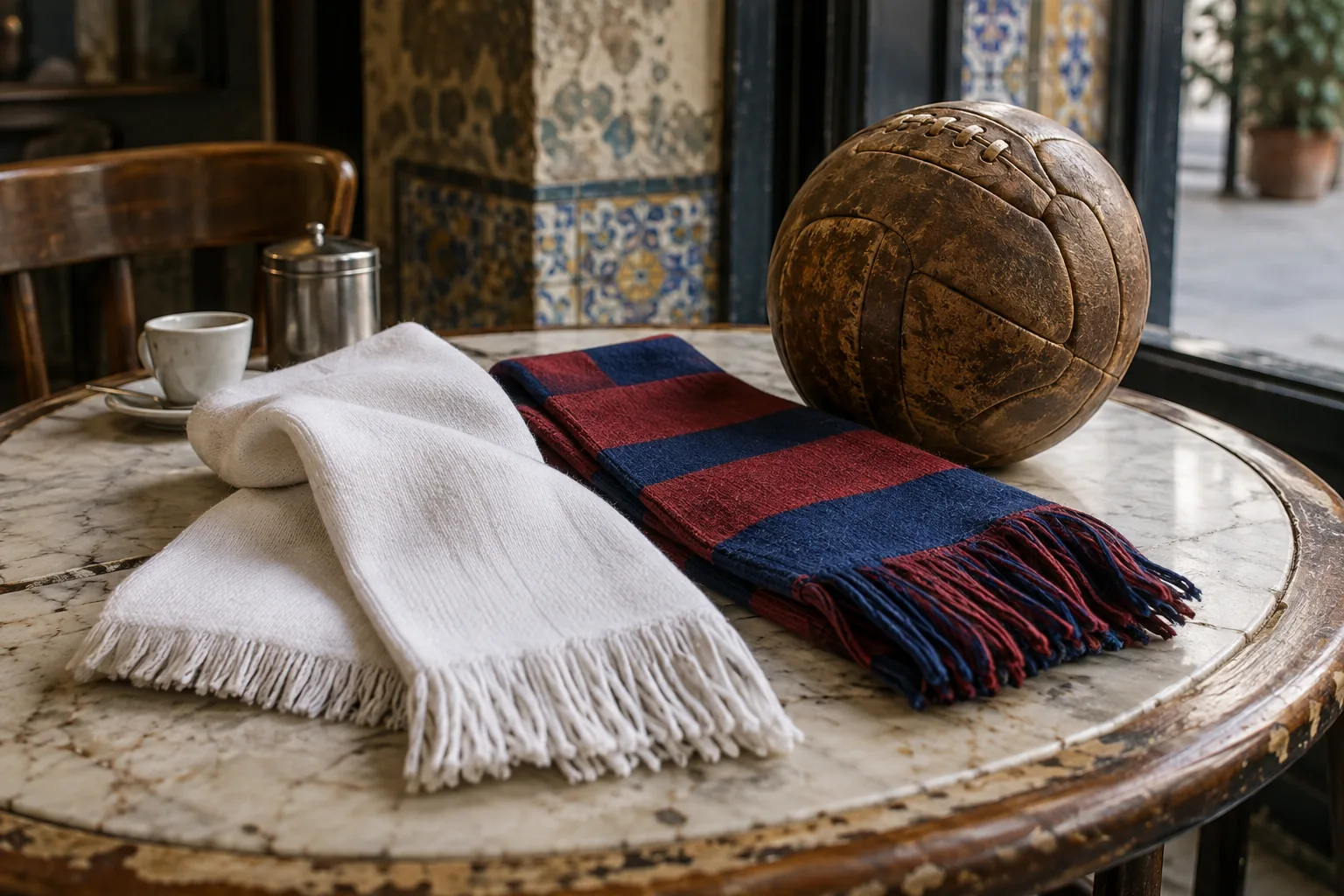
AI-generated editorial illustration of white and blue-and-claret scarves in a café. It is not a documentary photograph of an actual Clásico.
Updated: 16 October 2026
El Clásico history makes more sense as a sequence of different eras than as a list of records. Players, coaches and grounds change, while each generation remembers a particular match. A useful starting point is to separate the clubs’ first encounter from their first league meeting, then look at how memorable performances reflected the teams of their time.
1902 and 1929: two different starting points
FC Barcelona first faced Madrid FC on 13 May 1902 in the Coronation Cup, winning 3-1. The competition predated the Spanish league, and the Madrid club had not yet acquired the Real title. Calling that game the first league Clásico therefore combines two separate events.
The first league meeting took place at Les Corts on 17 February 1929. Madrid won 2-1, with Morera scoring twice and Parera replying for Barcelona. Barça won the return match 1-0 at Chamartín and went on to become the league’s first champions. Even in that opening season, winning one meeting did not tell the whole story of the campaign.
Big results, different football generations
Barcelona’s 5-0 away win on 17 February 1974 became closely associated with coach Rinus Michels and Johan Cruyff. Asensi scored twice, with Cruyff, Juan Carlos and Sotil completing the scoring. Naming the other contributors matters: the result was a team performance, even if Cruyff remains its most recognisable figure.
The rivalry produced an unusual exchange twenty years later. Barcelona won 5-0 in January 1994; Madrid answered with the same score in January 1995. Iván Zamorano scored a first-half hat-trick in Madrid’s victory, followed by goals from Amavisca and Luis Enrique. The matching scorelines belong to different stadiums, line-ups and league seasons, rather than a single two-legged contest.
Another generation supplied Barcelona’s 5-0 win in November 2010, when Pep Guardiola’s side faced José Mourinho’s Madrid. Xavi, Pedro, David Villa twice and Jeffrén scored. These games are valuable landmarks, but none can explain every period of the rivalry or predict the next meeting.
What does a Clásico statistic actually count?
Before comparing totals, check their scope. A league-only record differs from one that includes the Copa del Rey, Super Cup and European competition. Early tournaments may also be treated differently. The date of the count matters as much as the number itself: a historical article should not present an old total as a live record.
That approach also makes highlights more rewarding. Identify the venue and competition, note which team was at home, and place the result within its season. You can then appreciate a great performance without turning one scoreline into a claim about a century of football.
For practical arrangements, read our Clásico trip and viewing guide. The Real Madrid match catalogue is the place to check available listings; this historical overview does not announce a new fixture or promise tickets.
Further reading
Barcelona: the 1902 meeting · The 1929 match record · LALIGA: memorable Clásicos